Starting Secondary School: The Personal Safety Skills Every Child Should Know
Starting secondary school is a major step towards independence, and it brings a whole new set of personal safety challenges for children and parents. This guide covers the practical personal safety skills children need as they start secondary school, including walking to school alone, using public transport, phone safety, bullying, boundaries, situational awareness, knowing when to ask for help and what to do if something feels wrong. We also look at how parents can introduce physical self defence in an age-appropriate way
THE STREETWISE PARENT’S GUIDE - STARTING SECONDARY SCHOOL
Starting secondary school is a huge step.
New school. New teachers. New friends. A bigger building. Older children. More homework. And, for many children, a lot more independence.
Suddenly, the child you have been dropping at the school gate might be walking to school without you, catching a bus, going into town with friends or carrying an expensive phone around in their pocket (or more likely in their hand!).
As a parent, this bit can feel quite terrifying! And as the parent of 12 and 14-year-olds myself, it is something I have recently experienced.
You want them to grow up. You want them to have freedom, confidence and independence. But you also know that they're going to encounter situations where you're not standing next to them telling them what to do.
So how do we prepare them without completely frightening them?
That's what this guide is about.
At Streetwise Defence, we don't believe children's safety education should begin with teaching them how to fight. Real self defence and personal safety starts much earlier than that.
It's about awareness, prevention and mindset first.
Can they recognise when something doesn't feel right?
Can they make a good decision under pressure?
Can they say no?
Can they get themselves away from a situation?
Can they ask for help?
And, as an absolute last resort, do they know that they have the right to physically defend themselves if they're genuinely in danger?
Those are skills for life - and starting secondary school is a particularly good time to have these conversations.
Start before the first day
One of the easiest ways to teach personal safety is not to make it a big serious safety talk on their first day. You want their first day to be fun and positive, so springing safety concerns on them last minute won’t help.
Instead, talk about situations in advance and as they naturally come up. The summer holidays give you plenty of time to do this in a relaxed way.
If your child is going to walk to their new school, walk the route together beforehand.
If they're going to catch a bus, do the journey together.
If they'll be walking with friends, talk about what happens if the group splits up.
Road safety
The government's THINK! road safety campaign specifically recommends practice journeys and conversations about road safety before children start travelling independently.
There's good reason for that: its data shows child pedestrian casualties double between the ages of 9 and 11.
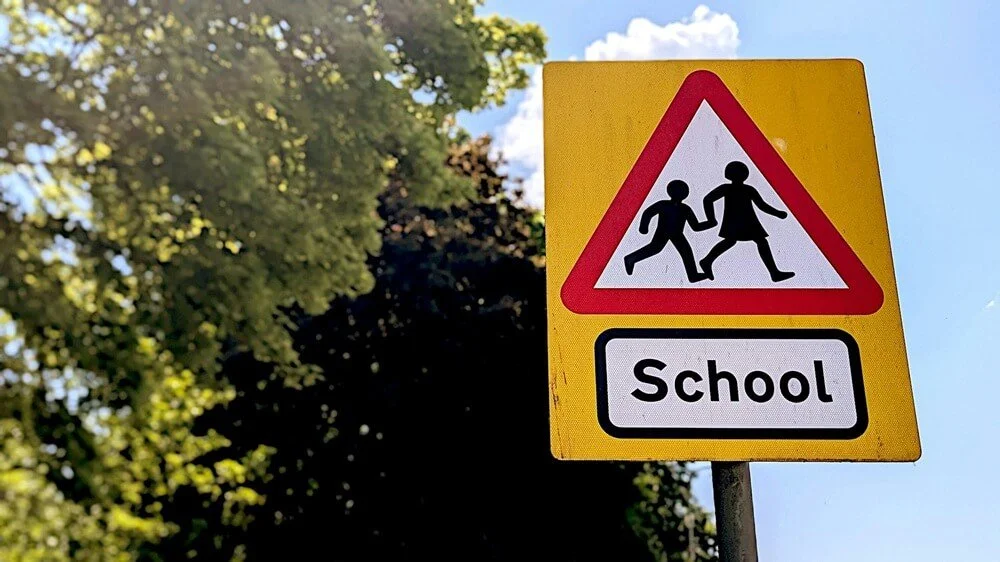
Distraction from friends and mobiles, rushing, and choosing unsafe places to cross are highlighted as particular risks.
So walk the route and look at it through your child's eyes. As you walk, talk about:
Where are the busy roads?
Where are the safest crossings?
Are there quiet stretches?
What shops, cafés, libraries or other public places could they go into if they felt unsafe?
Where could they get off the bus if there was a problem?
Conversation starter
You could simply say:
"We're going to practise your school journey today. Imagine I'm not here. Show me what you'd do."
Then throw a few gentle questions into the journey:
"Where would you cross?"
"What would you do if you missed the bus?"
"What if your phone battery died?"
"If somebody was making you uncomfortable, where could you go?"
You don't need to give them a lecture, just have a calm, casual chat to get them thinking in a safety mindset.
Phone AWAY, head up
This is my number one piece of safety advice for all children - put your phone away when you are out and about.
Phones can be great. They allow our children to contact us, check bus times, use maps and get help. But they are also incredibly distracting.
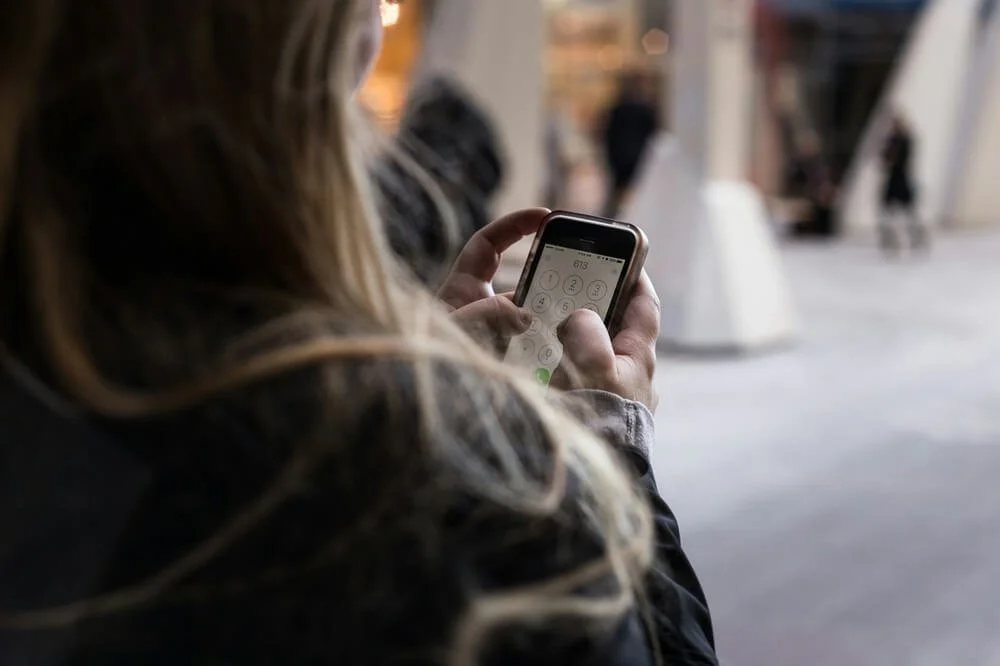
If your child, like most school children, walks along with their head down, eyes glued to the phone in their hand then they are:
Zoned out from what is happening around them
Advertising that they have a valuable phone that is easily available
Why being zoned out is an issue
Looking at a phone while walking means that children don’t notice what is going on around them.
That could be a car pulling up alongside them, someone following them or an incident occurring nearby. These are all things that could lead to dangerous situations and that, if they were paying attention, they could avoid.
Last year, at our secondary school, two children were knocked down by cars when crossing the road due to walking out into traffic while looking at their phones. This was horrifying for everyone involved and could have been avoided by putting the phone away and paying attention.
Advertising your valuables
When Dene teaches personal safety and self defence workshops in schools he asks students the question:
“Would you walk along holding a wad of money in your hands - perhaps three, four or five hundred pounds in cash?”
The answer is generally no, because you would feel conspicuous and vulnerable. Yet many mobile phones are worth that amount, or more!
Sadly, phone snatching is rife; statistics suggest that around 10,000 mobile phones are stolen every month in London alone. We have been called to deliver workshops in schools, specifically because phone snatching is an issue outside school gates.
So, if there is one rule to frequently reinforce, it is ‘put your phone away’.
What about headphones?
Adding headphones into the mix means your child is losing one of their important senses - their hearing. This is crucial for all the reasons we discuss above.
Our view is that headphones shouldn’t be worn when walking. But if your child is going to do it anyway, perhaps encourage them to leave one out (if the design allows it) or to take them off when crossing roads or in busy areas.
It should be noted that expensive headphones are also targets for theft in young people as well.
Teach them to notice without making them paranoid
One of the things we teach is ‘situational awareness’, which can sound a bit complicated and serious.
It isn't.
It basically means:
What's going on around me?
Children are actually quite good at this when you turn it into a game, especially if you develop this skill from a young age. Try occasionally asking:
"What did you notice?"
Perhaps you've just walked through a shopping centre.
Who was around?
Which exit did you come through?
Was there a security guard?
Where was the nearest shop?
Did anything feel unusual?
Don't constantly test them. They'll soon get fed up!
Just do it occasionally.
The aim is for looking around and noticing to become automatic.
Conversation Starter
When I notice something a bit off I often ask my children if they noticed it and what they think of it.
“Did you see those men standing over there? Did you think they looked suspicious? Why?”
“Did you notice that girl walking along looking at her phone with headphones on? Do you think that is safe?”
“Did you hear that car pull up behind us? What could we do to avoid it?”
I always keep the discussion calm and casual and then afterwards move us on to a different more positive topic.
I don’t want them to be scared - just have a healthy dose of reality.
Trust that funny feeling
Another crucial concept for young people is to listen to that feeling when something isn't right.
Sometimes there is an obvious reason. Sometimes there isn't.
Maybe somebody is walking behind you and has been there for several turns.
Maybe somebody on the bus keeps watching you.
Maybe an older child is being overly friendly.
Maybe your friend's new boyfriend gives you a strange feeling.
We can be so worried about being rude that we override our instincts. Personally, I'd much rather my children were rude and safe.
So give them permission to act, to say no and to walk away without explanation.
They don't need proof that someone is dangerous before moving away.
They can cross the road.
Go into a shop.
Sit near the driver.
Call you.
Walk towards other people.
Change direction.
Introduce them to the idea of ‘gut instinct’. Tell them it is a weird, uncomfortable feeling that is their body’s personal warning alarm when something is wrong.
What if somebody is following them?
This is a useful scenario to discuss because it teaches several safety principles at once.
Imagine your 11-year-old is walking home and notices the same man behind them after several turns and they’ve got a weird feeling about it.
What should they do?
First: don't go home.
You don't want to lead somebody you're worried about to your house.
Go somewhere busy instead.
Cross the road and see whether the person follows.
Go into a shop, café, pharmacy or other public place.
Tell an adult clearly:
"I think somebody is following me. Can I stay here while I call my mum/dad?"
Phone you.
If they genuinely believe they're in immediate danger, call 999.
Conversation starter
Ask:
"Imagine you're halfway home and you think someone is following you. What would you do?"
Let them answer first.
They may come up with things you haven't thought of.
Then work out a family plan together.
This is far more useful than simply saying, "Be careful walking home."
What does be careful actually mean?
Give them something they can do.
What about groups of older teenagers?
This is something lots of younger children (and adults!) find intimidating.
Your natural reaction when walking towards a group of older teenagers can be to look down at the floor, shrink yourself and avoid looking at them.
We teach the opposite.
You don't need to stare at them.
You certainly don't need to challenge them.
Just stay relaxed, keep your head up, look where you're going and walk purposefully.
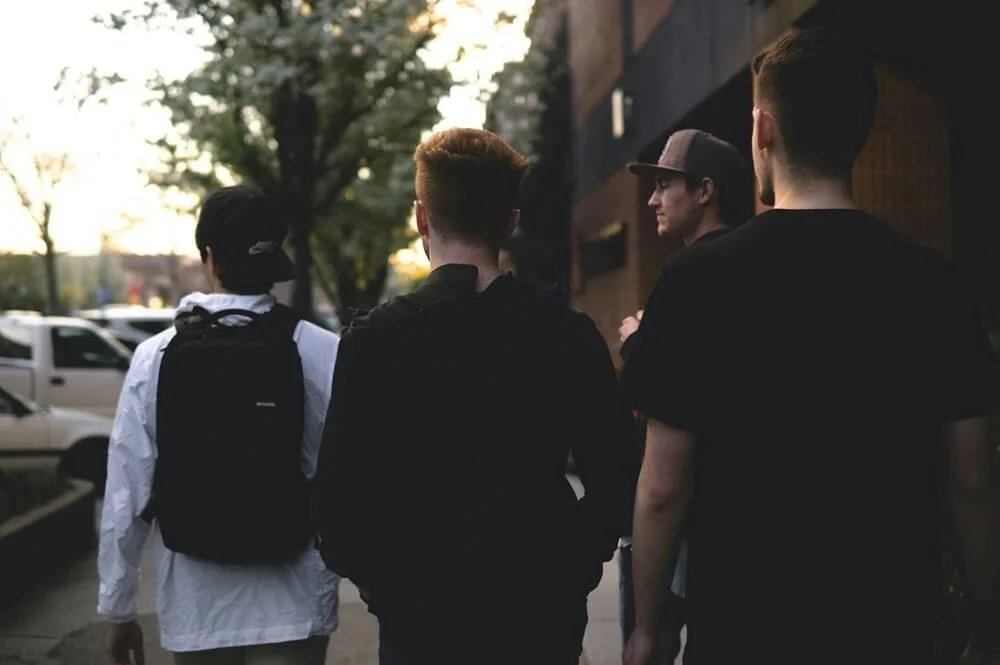
If something genuinely feels wrong, there is absolutely nothing cowardly about crossing the road, changing direction or going somewhere else.
Avoiding trouble is good self defence.
I've talked about this with my own girls when we've been out together. The aim isn't to make them think every group of teenagers is dangerous - because clearly they're not.
It's simply teaching them:
Notice. Assess. Make a decision.
That is a skill they'll use for the rest of their lives.
Give them permission to say NO
This is a big one.
Teaching children how to advocate for themselves, set boundaries and say no is one of the most important personal safety skills we can give them.
We spend years teaching children to be polite.
Say please. Say thank you. Don't interrupt. Don't make a scene.
Then suddenly expect them to stand up to someone when something makes them uncomfortable.
That's difficult.
We think it’s important to teach boundaries from childhood - including not forcing children to hug or kiss people when they don't want to.
The message is simple: your body belongs to you and you are allowed to have boundaries around it.
When children move into secondary school, this becomes even more important.
Their friendship groups change.
Relationships begin to change.
Peer pressure increases.
They need to know they can say:
"No."
"Stop."
"Don't touch me."
"I don't want to."
"I'm leaving."
And they need to know that you'll back them up.
Create a "no blame, no shame" home
This could potentially protect your child more than almost anything else in this article.
Your child needs to know they can call you when they've messed up.
Not just when they've done everything perfectly.
Because teenagers make mistakes. We made mistakes. They're going to make mistakes too.
Perhaps your child told you they were going to one friend's house and went somewhere else.
Perhaps they got on the wrong bus.
Perhaps they broke a rule.
Perhaps they did something online they shouldn't have done.
And then something goes wrong.
You want their first thought to be:
"I need Mum/Dad."
Not:
"I can't tell Mum/Dad because they'll kill me."
We call this creating a "no blame, no shame" culture - dealing with what happened, solving the immediate problem and keeping that line of communication open.
That doesn't mean no consequences.
It doesn't mean children can do whatever they want.
It means:
Safety first. Consequences later.
One sentence I think every child should hear
Tell them:
"If you're ever somewhere you shouldn't be, doing something you shouldn't be doing, and you feel unsafe, call me. I will come and get you. We can deal with everything else afterwards."
That's worth repeating occasionally.
What should they do if someone wants their phone?
Phones create another problem for children starting secondary school.
They may be carrying a device worth hundreds of pounds, perhaps for the first time.
Police advice recommends being aware of who's around when using a phone in public, not leaving it sitting out and being particularly careful about people watching passcodes or attempting to distract you before taking it.
But the most important Streetwise rule is even simpler:
Your phone is replaceable. You aren't.
If somebody threatens your child with violence and demands their phone, our advice is not to fight them over it.
Give them the phone.
Move away.
Get somewhere safe.
Tell an adult.
Call the police.
We make exactly the same point in our school workshops: never get into a physical altercation over a phone, money or belongings. Stuff can be replaced.
That's an important conversation to have because your child's instinct may be:
"But it's my phone!"
Yes.
And it isn't worth being seriously injured for.
Bullying doesn't necessarily stop at the school gate
Secondary school can bring a whole new social world. Unfortunately, that can also mean bullying. And now it doesn't necessarily end when school ends.
There can be messages, group chats, social media, AI-generated nudes and fakes, and rumours travelling around online at night.
Make sure your child knows that bullying isn't something they just have to put up with.
Listen to them.
Don't immediately tell them what they should have done.
Try:
"Tell me what happened."
Then:
"What would help?"
Keep screenshots and records of online bullying.
Record dates and incidents.
Contact the school.
And put important conversations and agreements with school in writing.
Schools also have formal safeguarding responsibilities for pupils while children are in their care, and parents can ask to see the school's health and safety and safeguarding arrangements.
Most importantly: make sure they know that you are there for them and they can tell you anything without judgement.
Bullying can have lifelong emotional and psychological consequences - take it seriously.
Phones at school are changing too
For parents in England, it's worth checking your new secondary school's phone policy rather than assuming your child will be able to contact you throughout the school day.
From September 2026, schools in England are expected to follow statutory Department for Education guidance prohibiting pupils' use of mobile phones throughout the school day. Individual schools will decide how they implement that - for example, phones switched off in bags or stored in lockable pouches.
So talk through:
If you need me during school, what do you do?
Make sure your child knows the school's system rather than relying on their mobile.
Personally, I have told my children to say they’ve been sick if they need to come home and school won’t let them.
Have a family emergency plan
This doesn't need to be complicated. In fact, the simpler the better.
Make sure your child knows:
Their home address and an important phone number.
Who else they can contact if you don't answer.
A couple of safe places or people they can go to.
When they should call 999 rather than you.
CREATE A FAMILY CODE WORD
You could also have a family code word.
If somebody they weren't expecting ever came to collect them and said, "Your mum sent me", they could ask for the code word.
No word? Don't go.
This is also useful in the ever-worrying world of AI scams - where someone may clone a family member's voice, claim they need money urgently or even pretend they have been kidnapped.
Play the "What if?" game
This is probably one of my favourite ways to teach children personal safety.
Don't bombard them with terrifying scenarios.
Just occasionally throw in a What if?
Perhaps in the car or while you're making dinner.
"What if your phone died and you missed your bus?"
"What if your friend wanted you to go somewhere you weren't allowed?"
"What if somebody grabbed your phone?"
"What if you realised someone had been following you for five minutes?"
"What if your friend got into a car with someone and you thought something wasn't right?"
"What if someone at school threatened you and told you not to tell?"
Then ask:
"What would you do?"
Don't jump in with the answer. Let them think. That's the point.
We don't just want children who can repeat safety rules.
We want children who can think under pressure.
And finally - what about physical self defence?
Yes, we believe children should know how to physically protect themselves.
But this comes last.
Not first.
If your child can spot a problem, avoid it, walk away, run away, get help or de-escalate it, that's a much better outcome than fighting.
Physical self defence is for situations where those options have failed and there is a genuine need to protect themselves or someone else.
Our school training follows exactly this approach: awareness, prevention, boundary setting, de-escalation and emotional resilience sit alongside physical skills - not underneath them.
Children should also understand that the response has to fit the situation.
A playground disagreement is not the same thing as somebody attempting to seriously harm or abduct them.
Teaching that distinction matters.
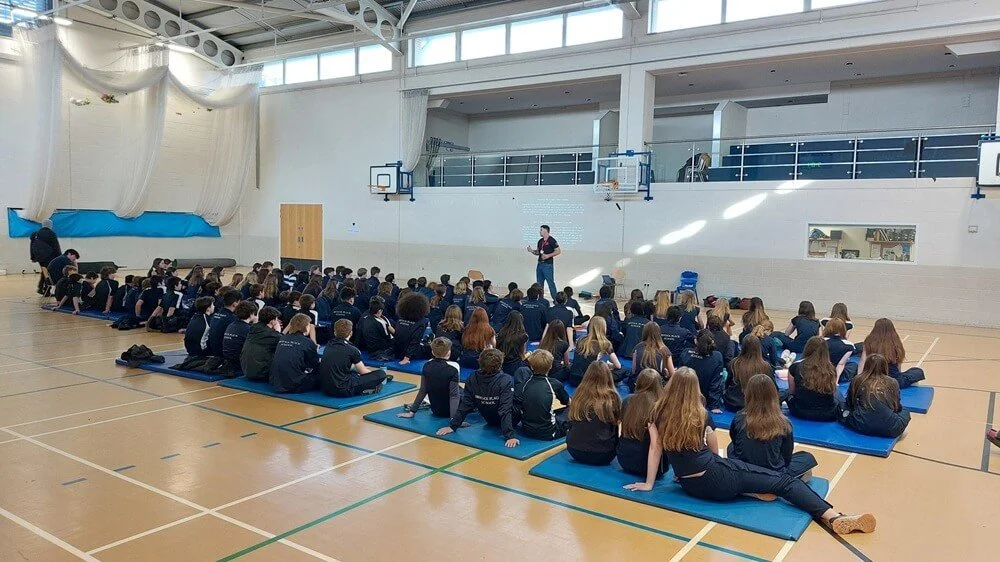
Streetwise Defence Co-Founder, Dene Josham, teaching a personal safety workshop at a secondary school
If you want your child to learn physical self defence
My suggestion to parents is actually to learn some basic self defence yourself first.
That way, you can understand the principles, see how the techniques work and then decide what feels appropriate to share with your child based on their age, maturity and stage of development.
You know your child better than anyone.
Some children may be ready to understand more about physical self defence at 10 or 11. Others may need things kept much simpler for a while.
The important thing is that what you teach them is appropriate, proportionate and clearly explained as a last resort.
We have a range of online Streetwise Defence courses that parents can complete at home, with lots of demonstration videos showing the techniques clearly.
You can start with our 1-hour Essentials course for £24, which covers the core principles and basic physical skills. You can then practise them yourself and share the parts you feel are suitable with your child.
I think this is often a much better approach than simply sending a child off to learn techniques without the parent really understanding what they are being taught or how those skills should be used.
For us, the aim of self defence isn't to win a fight.
The aim is to get home safely.
You can also ask your child’s school to host Streetwise Defence workshops for students.
The goal is confidence, not fear
Starting secondary school can feel like the beginning of letting go. And that's hard.
We can't follow our children everywhere.
We can't remove every risk.
And actually, we shouldn't try.
Our job is gradually to give them the skills to make good decisions when we're not there.
So have the conversations.
Walk the route.
Play the scenarios.
Teach them to put the phone away and look up.
Give them permission to say no.
Tell them they can always call you.
And remind them that being aware isn't the same as being afraid.
We don't want to raise frightened children.
We want to raise confident, capable young people who know they are worth protecting.
Want more practical safety tips?
We’ve put together 50 Streetwise Safety Tips covering everyday personal safety for you and your family.
Sign up to receive all 50 tips and we’ll also send you a 30% discount code for our online self defence courses.
About Streetwise Defence
Streetwise Defence provides trauma-aware, inclusive personal safety and self defence training for schools, organisations and individuals.
Our approach is based around four pillars - Awareness, Prevention, Mindset and Physical - with physical self defence taught as a last resort.
We have trained thousands of children and adults in practical, real-world personal safety skills, helping people feel more confident, aware and prepared.
This article is the first part of The Streetwise Parent's Guide, our series helping parents raise confident, aware and safety-conscious children without frightening them.