
Our Approach to Self Defence
Most people think self defence means learning how to fight or learning martial arts.
At Streetwise Defence, we teach something different.
Real-world self defence isn’t about punching, kicking or just learning a few physical moves. It’s about understanding danger earlier, reducing risk where possible, managing fear, setting boundaries and knowing how to protect yourself physically if you ever have no other choice.
That is why we created our 4 Pillars of Self Defence - to help people realise there is so much more to self defence than just the physical.
Because there are no winners when things turn physical. So, why would you fight when it could be avoided in the first place?
The Streetwise Defence 4 Pillars of Self Defence
Our framework is built around the four key areas of:
Awareness
Prevention
Mindset
Physical
Together, these four pillars help people feel safer, stronger and more confident in everyday life - without needing to become aggressive, fearful or physically strong.
By the way, notice that physical comes last? That’s because it is the last resort and to be avoided unless absolutely necessary.
Self defence is not the same as martial arts
When people get in touch with us about self defence training they often, quite naturally, come with pre-conceived ideas about what self defence is.
Many people think martial arts and self defence are the same. And while martial arts can be brilliant for fitness, discipline, confidence and skill. Martial arts and self defence are 100% not the same thing.
Most martial arts are taught in controlled environments, with rules, mats, known partners and time to prepare.
Real life is different.
A frightening situation may happen suddenly. It may involve fear, shock, confusion, pressure, alcohol, a familiar person, a public place, a private home, a workplace, a night out or a moment where something simply does not feel right.
Real violence is up close, messy, frenzied and vicious - there are no rules other than what you and the other person are willing to do to survive.
That’s why effective self defence training needs to go beyond physical techniques, and the physical needs to be simple, easy to remember and highly effective in real-life situations.
Self defence training should help people understand behaviour, boundaries, fear, decision-making, de-escalation, the law and how to act under pressure.
Our training is not about fighting.
It is about staying safer by avoiding dangerous situations and, if necessary, doing what you need to do to get away safely.
Why our approach is different
Streetwise Defence training is built on a rare mix of professional experience, trauma-informed practice and lived experience.
Dene Josham has over 30 years’ experience across security, close protection, violence prevention and self defence. His background includes high-risk security work, protecting high-profile clients and training thousands of people to stay safer in everyday life. Dene has also experienced street violence as a young man and understands the consequences of violence all too well.
Julie Waite brings lived experience of harassment, intimidation and sexual violence, which helps shape the emotional side of the training - including confidence, boundaries, self-worth and the realities many people face when they feel unsafe.

This combination matters.
Because self defence is not just about what your body can do.
It is also about what your brain does under pressure.
Why people freeze.
Why people ignore their instincts.
Why boundaries can feel difficult.
Why fear can take over.
Why simple, realistic options matter.
The Streetwise Defence 4 Pillars were created to bring all of this together in a way that is practical, accessible and grounded in real life.
The Streetwise Defence 4 Pillars of self defence
1. Awareness
Awareness is the first pillar of self defence because most situations do not start with physical violence.
They start with something changing.
A person’s behaviour.
The atmosphere.
Your gut feeling.
The space around you.
The way someone is looking at you, speaking to you or moving towards you.
Awareness is not about being paranoid or constantly on edge.
It is about learning to notice what is happening around you and giving yourself permission to respond sooner.
In Streetwise Defence training, awareness means understanding people, places, behaviour, body language, early warning signs and your own instincts.
Because the earlier you notice something feels wrong, the more options you usually have.
2. Prevention
Prevention is about the small choices that can stop a situation becoming more dangerous.
That might mean changing direction.
Moving closer to other people.
Creating distance.
Leaving earlier.
Protecting your phone or valuables.
Not worrying about seeming rude.
Choosing not to explain yourself to someone who is making you uncomfortable.
Prevention does not mean the responsibility is on you if someone else behaves badly.
It means giving yourself practical options before a situation reaches the point where you have fewer choices.
Good self defence training should never just teach people what to do when something has already gone wrong.
It should also help them recognise risk earlier and avoid danger where possible.

Danger isn’t always obvious - did you know that statistically you are more likely to experience violence from someone known to you
3. Mindset
Mindset is one of the most overlooked parts of self defence.
You can sense something is wrong, but still talk yourself out of it.
You can doubt your abilities when you are naturally powerful.
You can need to say no, but feel pressure to keep someone else comfortable.
You can forget how important you are and that you are worth fighting for.
That is why mindset is central to the Streetwise Defence approach.
Mindset is about believing you are worth protecting.
It’s about reconciling in your mind in advance that you have the right to get home to your loved ones.
It’s about understanding fear, trusting your instincts, setting boundaries and giving yourself permission to act.
This pillar is especially important because many people have been taught to be polite, accommodating or quiet, even when something feels wrong.
Real self defence helps people recognise that their safety matters more than someone else’s opinion of them.
4. Physical
Physical skills are important.
But they are the last resort, not the whole of self defence.
At Streetwise Defence, physical self defence is taught as simple, practical options that work no matter how strong or big or powerful you are. Yes, really!!
We do not teach people to fight; we teach you to survive.
We do not rely on complicated moves; you can learn them just by watching our demos.
We do not expect people to be strong or fit; our techniques level the playing field.
Our approach is based on realistic techniques that target the body’s natural vulnerabilities - so ordinary people can understand and use them under pressure.
The aim is not to win a fight.
The aim is to survive.
Physical self defence should always be taught responsibly, with clear safety guidance and an understanding of the law. Any physical response should be necessary, proportionate and focused on protecting yourself or someone else.
Why trauma-informed self defence matters
People come to self defence training for many different reasons.
Some want more confidence.
Some are worried about walking alone.
Some are preparing for university, travel or a new stage of independence.
Some have had a frightening experience.
Some are survivors.
Some are parents, schools or employers wanting to support others.
That’s why our training is trauma-informed, inclusive and carefully delivered.

As survivors of violence ourselves, we know how triggering this type of training could be.
To support you we:
Always give trigger warnings before sensitive content
Have the option to take a break and return
Share our own experiences and those of other survivors
Never force people to answer questions or take part in role play
Demonstrate the physical so you can learn by watching - participation in physical is entirely optional
Offer follow-up support and resources.
Our aim is to leave people feeling more prepared, more capable and more in control.
Who the Streetwise Defence 4 Pillars are for
Our 4 Pillars of Self Defence are used across our training for individuals, families, schools, colleges, universities, workplaces and community groups.
This approach can support:
Individuals who want to feel safer and more confident
Parents who want to help their child prepare for more independence
Schools and colleges looking for age-appropriate personal safety training
Universities supporting students with real-world safety skills
Workplaces investing in staff wellbeing, confidence and personal safety
Women’s groups, LGBTQ+ groups and community organisations looking for inclusive, practical training
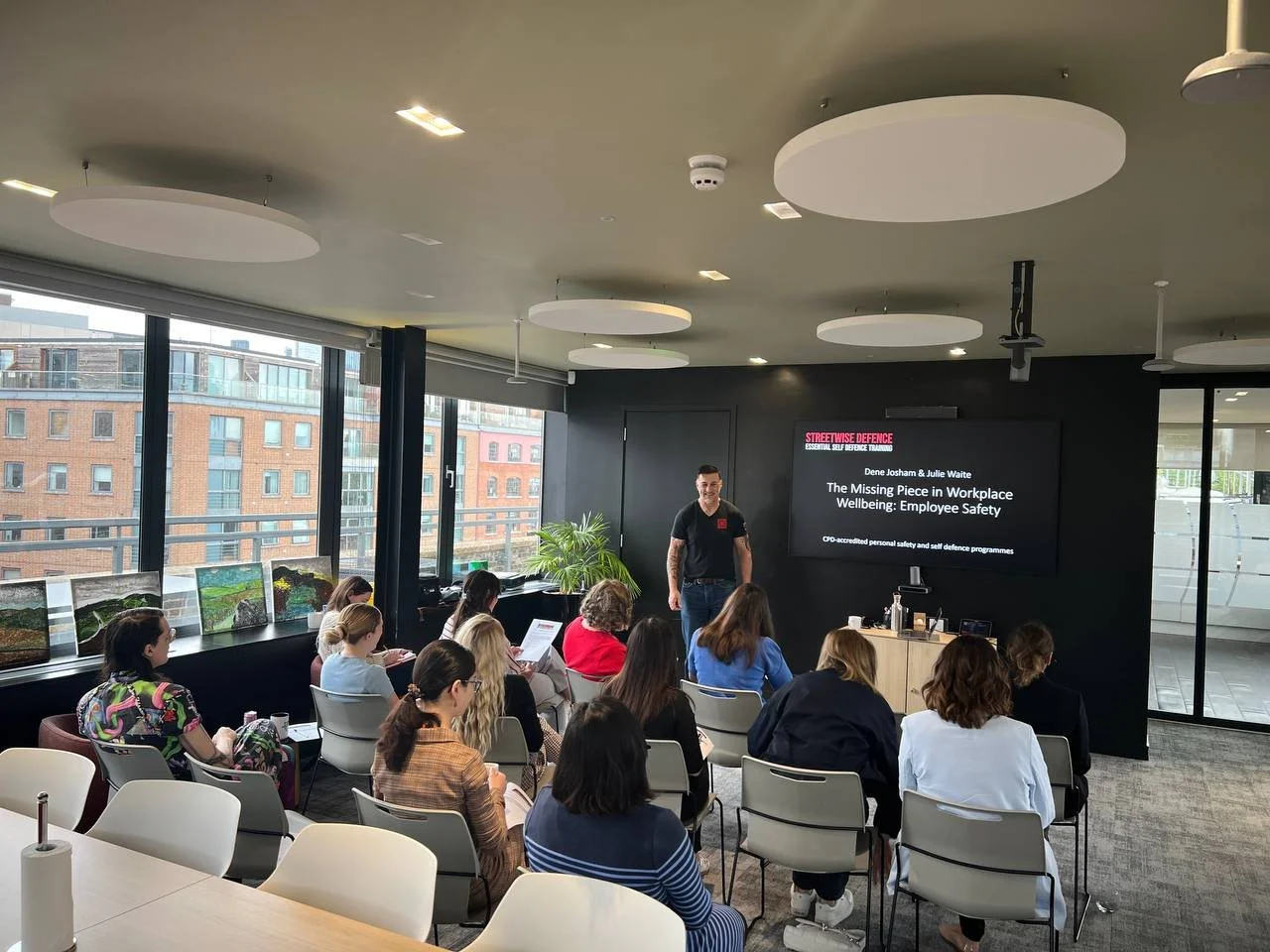
Dene training a women’s group at a workplace
The situations may be different, but the foundation is always the same:
Awareness
Prevention
Mindset.
Physical
What makes Streetwise Defence training different?
Streetwise Defence is not martial arts.
It’s not fitness-based self defence.
It’s not a few techniques taught in isolation.
It is personal safety and self defence training built around real-life experience, trauma-informed practice and an understanding of how violence, fear and human behaviour actually work.
Our training helps people think differently.
Not just:
“What would I do if someone attacked me?”
But:
“How can I notice danger earlier?”
“How can I reduce risk before it escalates?”
“How can I trust myself when something feels wrong?”
“How can I set a boundary?”
“How can I stay calmer under pressure?”
“How can I protect myself if I have no other choice?”
People tell us our training helps them feel more confident and empowered.
That’s the difference.
Common Questions About Self Defence
What is self defence?
Self defence is not just learning how to fight. Real self defence includes awareness, prevention, mindset and physical skills. At Streetwise Defence, we teach these through the Streetwise Defence 4 Pillars of Self Defence, helping people notice danger earlier, reduce risk where possible, manage fear and use simple physical skills as a last resort.
Is self defence the same as martial arts?
No. Martial arts can be excellent for fitness, confidence, discipline and skill, but self defence is different. Self defence needs to consider how violence happens in everyday situations, how fear affects the body and mind, how to avoid escalation, and how to respond lawfully and safely if you have no other choice.
Do I need to be fit or strong to learn self defence?
No. Streetwise Defence training is designed for ordinary people. Our approach does not rely on strength, fitness or complicated moves. We focus on simple, practical skills that help people feel safer, more confident and more prepared.
Why is mindset part of self defence?
Mindset matters because fear can affect how people respond under pressure. Many people freeze, doubt themselves, worry about being rude, or ignore their instincts. Mindset helps people trust themselves, set boundaries, manage fear and give themselves permission to act.
Why are physical skills the last resort?
Physical skills matter, but they should never be the whole of self defence. The aim is not to fight to win - there are no winners once things go physical, the aftermath and mental trauma of a physical incident can be severe and long-lasting. The aim is to survive - and this can mean creating space, escaping, and staying as safe as possible. That is why Streetwise Defence teaches physical skills alongside awareness, prevention and mindset.
Want to learn more?
The Streetwise Defence 4 Pillars sit at the heart of everything we do - from online self defence courses to school workshops, workplace training and private group sessions.
Explore the website to find the training that feels right for you.
Or, if you’re not sure where to start, drop us a note and we’ll point you in the right direction.