The Missing Link Between Workplace Wellbeing and Personal Safety
Organisations invest heavily in wellbeing - from mindfulness days to resilience workshops and flexible working - yet personal safety is often the missing piece in wellbeing.
Rising concerns about street harassment, commuting safety and personal boundaries all highlight one truth: people can’t thrive if they don’t feel safe.
Because safety - physical, emotional, and psychological - is the foundation everything else depends on.
This article explores the often-overlooked link between workplace wellbeing and personal safety - why fear quietly drains engagement and performance, and how to start building a truly safe culture.
If you’re involved in wellbeing, DEI or HR initiatives, you can benchmark your organisation with our free Workplace Safety & Wellbeing Scorecard (find it at the end) - a two-minute diagnostic revealing where hidden safety gaps may exist.
The Conversation We’re Not Having
A lot is happening in the world of ‘workplace wellbeing’. Workshops. Wellness days. Team challenges. Mental health support. Flexible working opportunities and much more.
All with great intentions - and often real investment.
But despite all the activity, something is still missing - personal safety.
Maslow’s Hierarchy of Needs
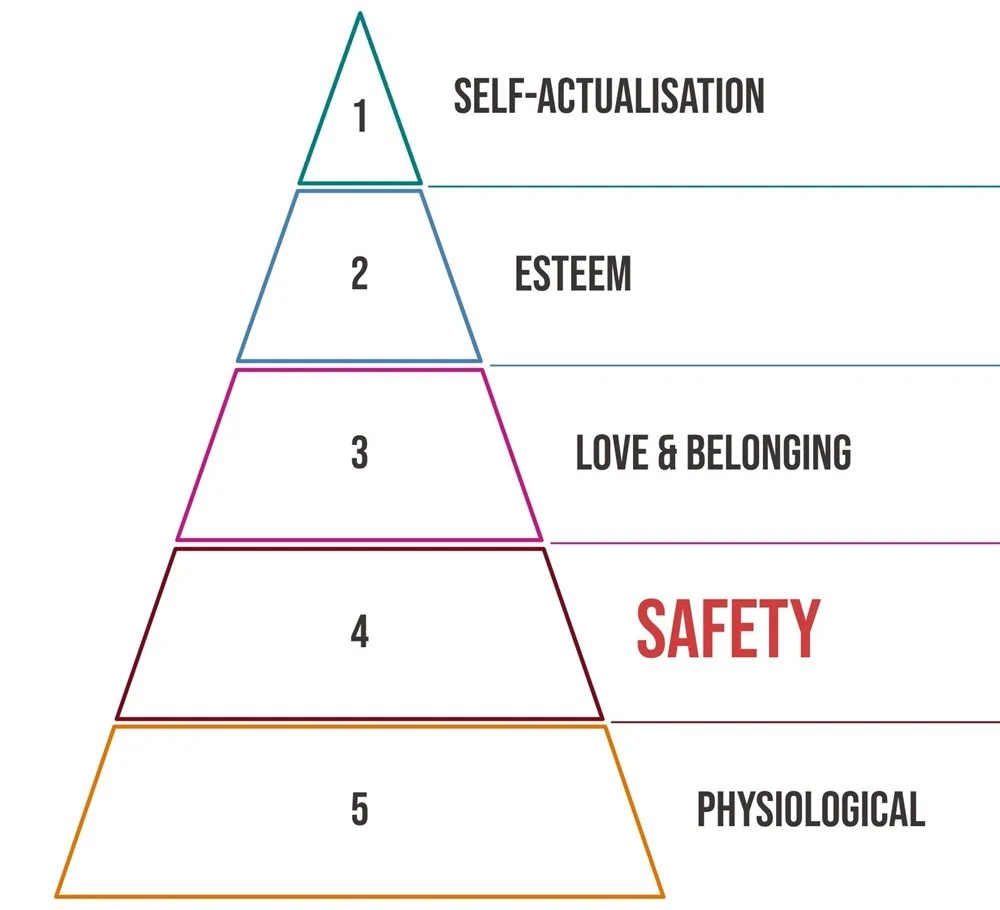
In Maslow’s Hierarchy of Needs, safety comes just above our most basic physiological requirements - food, water, shelter.
It’s the base that everything else rests on: belonging, confidence, achievement, growth.
And yet, it’s often the piece that gets overlooked.
Every week, we hear from organisations whose employees are struggling with fears that never appear on a wellbeing survey:
The person who was mugged on their commute.
The colleague replaying a confrontation that crossed the line.
The staff member masking the trauma of abuse, assault or harassment.
And the truth is, until people feel physically and emotionally safe, none of the higher-level needs - belonging, motivation, or performance - can truly thrive.
Because you can’t build belonging or performance on top of fear.
Fear has an economic footprint
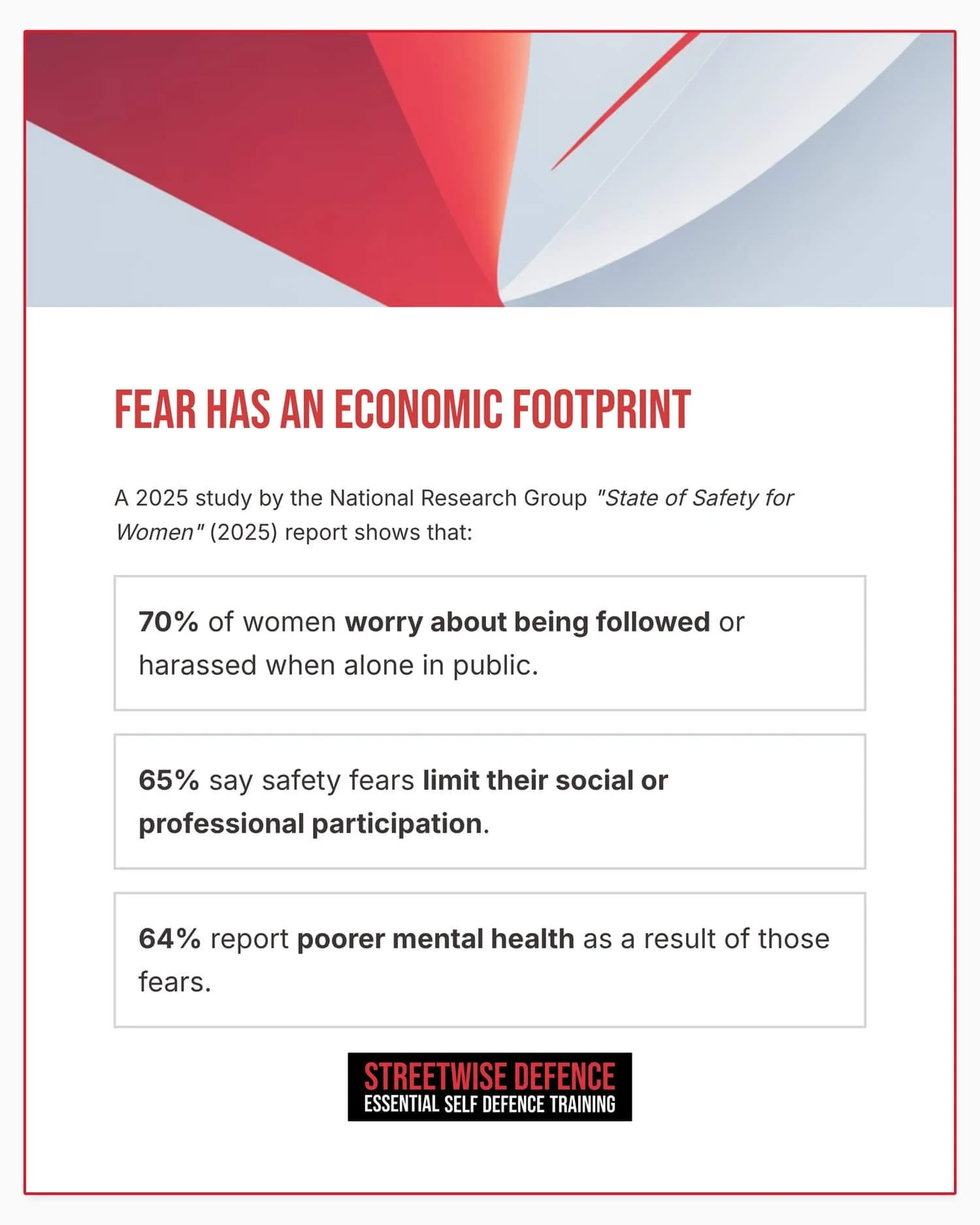
And the data backs it up. A 2025 study by the National Research Group “State of Safety for Women” (2025) report shows that:
70% of women worry about being followed or harassed when alone in public.
65% say safety fears limit their social or professional participation.
64% report poorer mental health as a result of those fears.
Those fears don’t disappear when people arrive at work - they travel with them.
When people are in survival mode, they’re not building culture. They’re not thinking strategically. They’re not connecting deeply with customers or colleagues.
And this impacts your business on so many levels, including the bottom line.
When employees operate from fear - even low-level, unspoken fear that is not connected to work - it changes how they think, how they interact, and how they perform.
This can look like distraction, fatigue, ‘quiet-quitting’, a voice that sounds flat in meetings or frequent absenteeism.
It’s the small adjustments people make every day to feel a little more in control. But collectively, those small adjustments add up. They cost energy, attention, creativity - the very things organisations rely on to innovate and grow.
WHAT DOES THIS MEAN FOR EMPLOYERS?
If we know that many people in our workplaces feel fearful and unsafe, and that this negatively impacts the business, what would the opposite look like?
The answer is simple.
It looks like a more confident, calm, content and empowered workforce and a more productive, dynamic and successful business.
When employees feel safe, they:
✅ Think clearly under pressure
✅ Communicate openly
✅ Collaborate without fear
✅ Handle conflict better
✅ Bounce back faster from challenges
It’s an organisation that values its people as employees and human beings and, in turn, receives increased productivity, retention and motivation.
Who wouldn’t want that?
The Business Case for Workplace Wellbeing and Safety
For HR and wellbeing leaders, the argument for workplace wellbeing and safety is both moral and commercial.
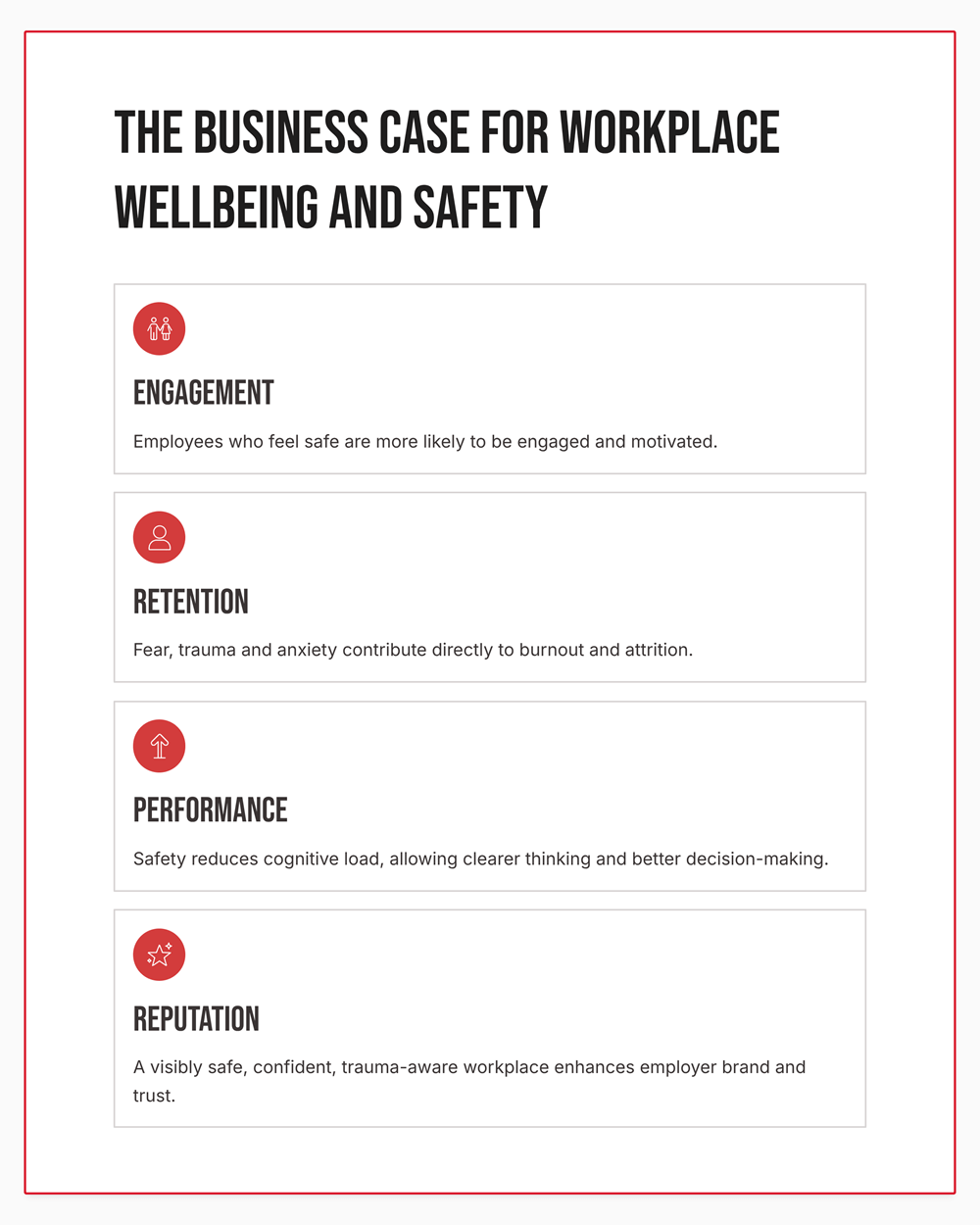
Engagement: Employees who feel safe are more likely to be engaged and motivated.
Retention: Fear, trauma and anxiety contribute directly to burnout and attrition.
Performance: Safety reduces cognitive load, allowing clearer thinking and better decision-making.
Reputation: A visibly safe, confident, trauma-aware workplace enhances employer brand and trust.
Plus, when employees understand the psychology of violence, particularly in social situations, they can better deal with customer aggression and manage their own response and behaviour more effectively.
However, convincing senior leaders to invest in personal safety training can be difficult as this is a fairly new element of workplace wellbeing, and yet another training to invest in.
That is why, unfortunately, when we are asked to go into an organisation to provide a workshop, it is often after an incident has happened (whether inside or outside of work). And we’ve seen the negative aftereffects of this spread far and wide throughout the organisation.
True personal safety includes the physical, emotional, and psychological layers that allow people to function confidently - both inside and outside of work.
Have We Missed a Critical Layer in Workplace Wellbeing?
As an employer, you can’t prevent what happens to someone outside work, but you can create an environment inside work where people feel seen, supported, and safe enough to ask for help. And you can give people the knowledge and skills to look after themselves as best they can.
That’s why it’s worth looking beyond individual wellbeing initiatives and asking a bigger question:
Does our current wellbeing strategy properly cover personal safety — or have we missed a critical layer?
Many organisations have strong frameworks for mental health, DEI, and belonging, but no clear approach to personal safety.
It’s a gap that undermines everything else - and one most wellbeing strategies were never designed to fill.
If you’re not sure where your own organisation stands, our Workplace Safety & Wellbeing Scorecard can help you find out - it’s quick, enlightening and confidential. (Link at the end of this article.)
How to Build a Safety-First Culture
If you’re leading HR, DEI, or wellbeing strategy, here are five practical steps to start strengthening safety across your organisation:
Acknowledge the link between safety and wellbeing.
Talk about safety openly - physical, emotional, and psychological. Name it as a wellbeing issue and ask your people how safe they feel.Review your current policies.
Ensure you have policies that support personal safety - and that people know how to access support confidentially.Train your leaders.
Ensure senior leaders understand the impact that an empowered, safe and confident workforce can have on your organisation.Equip people with skills.
Offer training that supports people to feel safer such as personal safety, self defence, conflict de-escalation and domestic abuse awareness training.Measure your progress.
Use tools like our Workplace Safety & Wellbeing Scorecard to identify gaps in your wellbeing strategy, and to benchmark and track improvements over time.
Why Personal Safety Has to Come First
If wellbeing is the goal, personal safety is the foundation that allows every other initiative - mental health, inclusion, leadership, performance - to flourish.
So before investing in another wellbeing campaign, pause and ask:
Do our people truly feel safe here - or have we built our strategy on unstable ground?
HOW DOES YOUR WORKPLACE score on PERSONAL safety?
Take our free Workplace Safety & Wellbeing Scorecard for an instant, confidential report and tailored recommendations.
About Streetwise Defence
Streetwise Defence delivers CPD-accredited personal safety and self defence programmes for organisations across the UK and worldwide.
If you’d like to learn more about how we support workplaces through live and online self defence programmes, visit our Corporate Self-Defence Training page.
We believe that when people feel safe - physically, emotionally, and psychologically - everything else grows.